

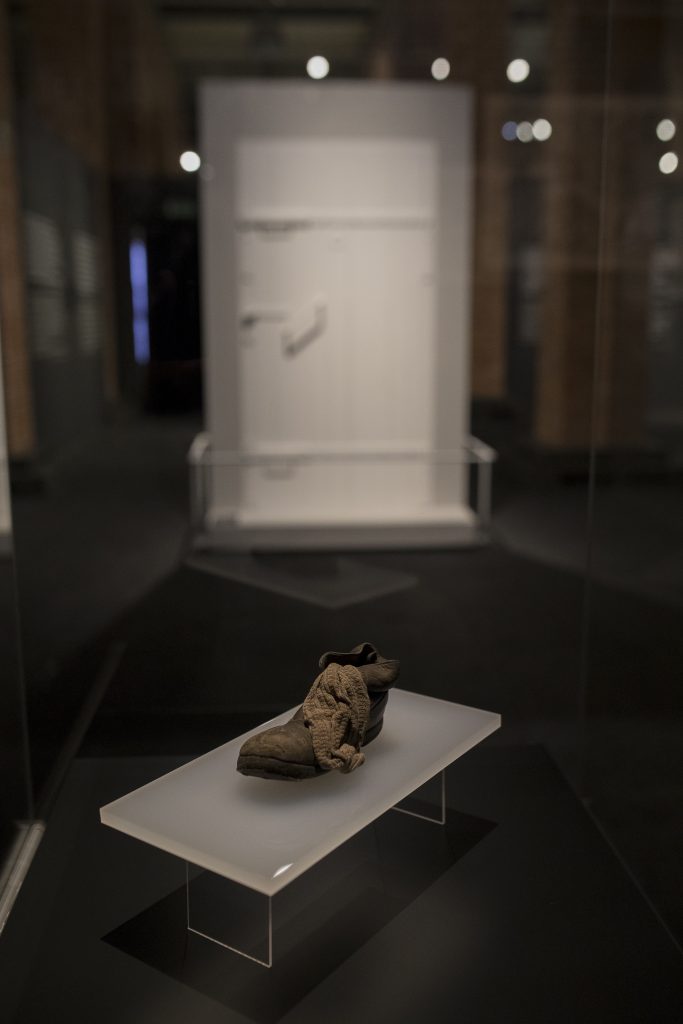
Some histories survive not only through documents or photographs, but through the objects left behind. A suitcase. A letter. A child’s shoe… These are more than historical artifacts — they are traces of lives interrupted, fragments of human stories that continue to speak long after their owners are gone.
At Musealia, original objects lie at the heart of every exhibition we create. Whether it is a personal belonging recovered from the Titanic, a piece of the Berlin Wall, or an artifact connected to Auschwitz, each object carries multiple layers of meaning: personal, historical, and emotional. They are not simply displayed as evidence of the past, but approached as silent witnesses to history — tangible connections between individual lives and the events that shaped the world.
Working with these objects is a profound responsibility that goes far beyond research and conservation. It requires constant reflection on narrative, context, and ethical responsibility. Behind every exhibition lies a deep commitment to accuracy, sensitivity, and humanity. To ensure this, Musealia works closely with historians, curators, survivors, experts, and cultural institutions. Every decision — from the selection of an object to the story that accompanies it — shapes how visitors encounter history. There are no neutral choices.
Paired with authentic artifacts that have extraordinary journeys of their own — some preserved by survivors or their families for decades, others surviving disasters, wars, divisions, displacements, or the passage of time itself — these objects transform history from something distan tinto something profoundly human.
Their existence today is often extraordinary in itself. Some are more than a century old, yet they continue to connect with visitors of all generations, becoming carriers of memory for future generations, and reminding us that history happened to real people.
Because in the end, preserving these objects is not only about safeguarding the past. It is about creating spaces for reflection in the present — spaces where memory, empathy, and understanding can continue to live on for future generations.