

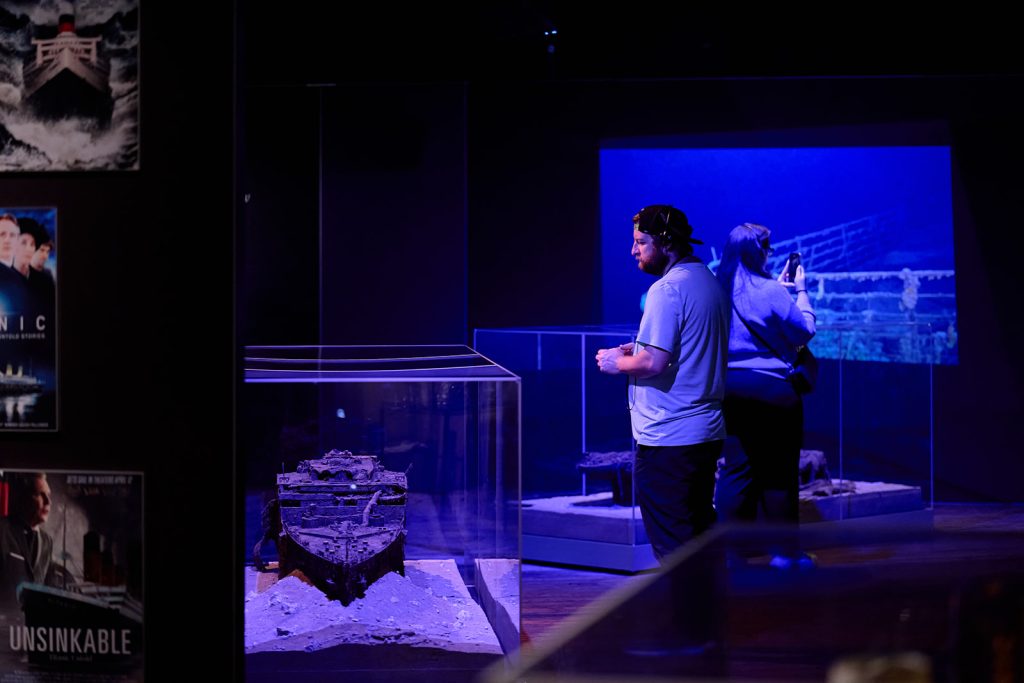
More than a century after the sinking of the RMS Titanic, its story continues to travel effortlessly across borders, generations, and cultures. Ask almost anyone, anywhere in the world, to name a ship, and the answer will often come without hesitation: Titanic. Its legacy has outlived the era that created it, evolving into something far greater than a historical event — it has become a shared cultural memory.
Part of this enduring fascination lies in the balance between scale and intimacy. The Titanic was, at the time, a marvel of engineering — a symbol of ambition, progress, and human confidence at the dawn of the 20th century. Yet its story is not remembered for its size or luxury alone, but for the deeply human narratives embedded within it. Beneath the grand design were thousands of individual lives: passengers full of hope, crew members carrying responsibility, families separated by class yet united by fate.
The disaster itself — the Sinking of the Titanic — unfolded over just a few hours on a cold April night in 1912. But its emotional and cultural impact has stretched across decades. What resonates is not only what happened, but who it happened to. Stories of courage, sacrifice, confusion, and survival continue to surface, each adding another layer to a narrative that refuses to settle into the past.
This is why the Titanic persists not only in history books but also in popular culture. From James Cameron’s 1997 Titanic, which reintroduced the story to a global audience, to countless documentaries, exhibitions, and reinterpretations, each generation finds its own way into the story. These retellings do more than recreate events — they reinterpret them, often reflecting contemporary values, questions, and emotions.
Yet beyond cinema and spectacle, there is something quieter that draws people in: the artefacts. Personal belongings recovered or preserved — letters, clothing, jewelry — serve as tangible connections to lives interrupted. They transform the Titanic from an abstract tragedy into something immediate and human. A handwritten note, a worn fabric, or a simple object carried across the ocean can bridge more than a century in an instant.
The ship was not just a voyage; it was part of a moment in history shaped by migration, social hierarchy, and technological optimism. For many passengers, the journey represented opportunity — a crossing toward new lives and uncertain futures. In this sense, the Titanic is not only a story about an ending, but also about beginnings that were never realized.
Perhaps what keeps the story alive is its openness. It is not fixed or fully resolved. New research, personal accounts, and interpretations continue to emerge, challenging long-held assumptions and inviting renewed reflection. Myths are questioned, overlooked figures are brought into focus, and the narrative evolves without losing its emotional core.
Ultimately, the Titanic endures because it speaks to something universal. It is a story about human ambition and vulnerability, about the tension between control and chance, and about the fragile boundary between ordinary life and extraordinary events. It reminds us that history is not distant — it is made of people not so different from ourselves.
In that sense, the Titanic does more than connect us to the past. It connects us to one another. Because in remembering them, we recognize something of ourselves.